

In response to the recent publication of the French-language summary of Volume 1 of the GIECO (International Group of Experts on Behaviour Change), which highlights the urgent need to fully integrate societal and behavioural dimensions in the face of environmental crises, this article considers why the social sciences should be better integrated into public procurement.
The social sciences reveal what is happening beneath the surface: power relations, unwritten rules and the ‘cultural’ factors that are depoliticised and passed off as ‘natural’.
In this fourth instalment of our series of articles (previous episode here), we explore the human factor in transitions with Manon Berge of ACTeon. She supports project teams working on changing perceptions and behaviours and, more broadly, on integrating sociological factors into the way transitions are approached.
Her message is clear: a sociologist provides an essential mirror for the transformation process, revealing hidden dynamics and accelerating collective action.
Beyond ‘social acceptability’: repositioning the social sciences

The use of the social sciences in environmental policy is all too often confined to diagnosis (e.g. understanding the dynamics between stakeholders), to certain aspects of policy evaluation, or even to the mere concept of social acceptability (at best as part of a genuine consultation process, and at worst as a means of ‘sweeping through a decision that has already been taken under the guise of pseudo-consultation’).
End-to-end support from the social sciences remains rare in public procurement, and there are few examples of genuine interdisciplinarity beyond research projects.
For Manon Berge, a sociologist at ACTeon, this view is too narrow and fails to reflect current challenges
There are sometimes commendable efforts to bring the social sciences into the initial assessment of an issue, through surveys that shed light on the social factors at play. However, in environmental policy, the translation of these findings into public action is often limited.
‘We would like to see the social sciences play a much broader and more fundamental role,’ she explains.
The aim is to combine the social and natural sciences from the outset and throughout projects. The social sciences should not simply intervene at the end of the process to oil the wheels: they should enable genuine interdisciplinarity and support transformation at every stage.
At present, however, public demand for this type of work remains insufficient.
This is not only a question of reluctance or fear of investing in these areas; it is also an economic issue for public procurement. At ACTeon, we recommend:
- Integrating the social sciences from the outset can save money during implementation. Investing in the process helps create projects that are better accepted, co-designed and easier to implement, reducing the risk of legal challenges, deadlock or delays on the ground.
- Prioritising tenders that incorporate a social sciences dimension throughout gives local authorities, institutions and contracting authorities a key role in valuing proposals whose methods take these human dimensions into account.
Three concepts for considering the contribution of the social sciences to ACTeon’s projects: reflexivity, process and transformative change
To understand the practical contribution of the social sciences, we need to consider three concepts that underpin ACTeon’s approach.
- Process rather than outcome. While the natural sciences often seek a finished, measurable and reproducible outcome, the social sciences pay particular attention to the process. ‘The social sciences focus more on the process and less on the outcome.’ It is through this collective and individual journey that norms and perceptions change. If the process is ignored, the result may be a technical deliverable that is never taken up by the people responsible for putting it into practice.
- Reflexivity: the power of the mirror. Reflexivity means stepping back from what we are doing, individually or collectively, while we are doing it. ‘It’s the idea of a mirror,’ explains Manon Berge. Drawing on the concept of the ‘reflective practitioner’, the aim is to catalyse learning. In projects, this means creating spaces for discussion in which stakeholders are shown a reflection of their own practices. ‘We spend time discussing people’s practices with them and guide them through this reflective process.’ This feedback helps build a shared understanding and accelerate learning.
- Transformative change. This is not simply an adjustment; it is a change of scale that alters social norms. ‘Transformative change affects a significant proportion of a population, to the point that what seems normal shifts significantly.’ Technical arguments alone cannot bring about this kind of change. We need to question ways of life, power dynamics and the deeper reasons why ‘we like streetlights’ before asking people to switch them off to protect biodiversity.
It is useful to clarify a few key terms:
- Social acceptability generally refers to the extent to which a decision, project or policy is tolerated or accepted by stakeholders and the general public. It is often assessed after the event, sometimes at the risk of being seen as a top-down tool for securing approval.
- Ownership, by contrast, goes much further: it means that stakeholders take a tool, process or project on board to the point of becoming its legitimate authors and champions. It marks a shift from a passive position—enduring or accepting something—to an active one—acting and transforming.
- Mutual acculturation occurs when stakeholders develop a shared subculture around an issue through their interactions. That shared culture then becomes the foundation for their joint thinking and action.
Feedback: when theory meets reality
Two projects perfectly illustrate the relevance of this approach: Natur’Adapt and Bridging Minds.
Natur’Adapt: making adaptive management work. This LIFE project (2018–2023), led by Réserves Naturelles de France, aimed to shift the management of protected areas towards an adaptive approach to climate change. Sociological monitoring was built into the project from the outset as a core part of its methodology. The five-year monitoring process included regular feedback sessions, creating a ‘mirror’ for project stakeholders and helping them develop their capacity for reflexivity and learning. The monitoring helped catalyse a shared ‘cultural’ framework for the project, strengthen awareness of its objectives and direction, and highlight the importance of the process in the methodology developed through Natur’Adapt. To find out more, read the article: Natur’Adapt: reflections on the sociological support provided to a LIFE project.
‘The partners agreed to go through this process together and to make themselves vulnerable during these moments of individual and collective reflection.’
Bridging Minds: training knowledge brokers.As part of the BioAgora project, Bridging Minds focused on people working at the interface between science, policy and society. Its aim was to strengthen their ability to take human factors and power dynamics into account in their decisions. ‘We often fall back on technical questions: why is a species disappearing? Because its habitat is being destroyed. But by whom? And why?’ says Manon Berge. The project showed that the social sciences cannot be overlooked if the aim is transformative change. Technical issues are often political, and ignoring that can lead to ineffective public policies. ACTeon also uses role-playing games to explore human factors, which can be difficult to grasp in the abstract. We chose role-playing for Bridging Minds because it is difficult to talk about human factors in the abstract,’ says Manon Berge. The game allows participants to experience emotions such as frustration and satisfaction, and to take part in the processes of negotiation and power. It accelerates awareness: ‘We’re not in the same state of mind at the end as we were at the beginning.’
‘The answer to this need: fostering a sense of community and democracy’

Our methods: from sociological research to role-play
Here are some examples of the range of approaches we use across different types of project:
- Designing and analysing online surveys to explore perceptions on a large scale.
- Providing sociological support through surveys and interviews to identify the factors that enable or obstruct change on a given issue.
- Taking a ‘mirror’ approach, as in the Natur’Adapt project.
- Using playful and interactive tools, such as serious games (including Human Factor), to make negotiation dynamics tangible.
- And much more, depending on the project’s needs and level of maturity.
The key challenge identified by Manon Berge for the coming years is that of community and democracy. “How can we collectively tackle environmental challenges? That is the central challenge.” The transition cannot take place if it is framed solely in technical terms; it is fundamentally political. That is why the social sciences are essential to the transition.
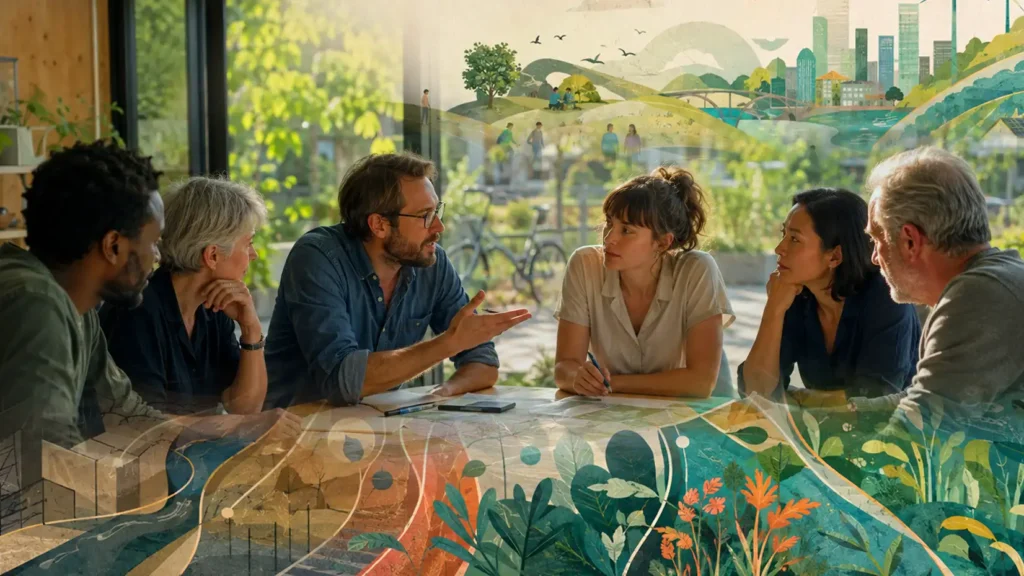
The social sciences reveal what is happening beneath the surface: power relations, unwritten rules and the ‘cultural’ factors that are depoliticised and passed off as ‘natural’. ‘The missing link is often the link between action and diagnosis: bringing decision-makers and those carrying out the diagnosis closer together.’
For ACTeon, the answer lies in an adaptive, co-constructed approach. ‘We try to apply to ourselves the culture we seek to instil in others: being adaptive and reflexive, and working through co-construction.’ This means bringing collective action into projects where it is not a given, with patience and creativity.
Don’t be afraid of the social sciences
If you are leading a project, an elected representative, a technical officer or an engaged citizen, Manon Berge’s message is simple:
‘Don’t be afraid of the social sciences.’
Talk to researchers and practitioners. Demystify these disciplines. Stakeholders are often interested, but feel trapped in a system that leaves them too little room to manoeuvre. Yet, as the example of Réserves Naturelles de France shows, a committed project lead can create space for genuine interdisciplinarity and innovation.
“The social sciences encourage us to adopt a certain mindset: one of continuous learning, self-reflection and adaptability. Because, ultimately, the ecological transition is, above all, a story about people, meaning and community.”
En conclusion et pour reboucler sur notre introduction, nous vous invitons à compléter cette lecture par le très intéressant rapport 2026 du GIECO : https://www.alliancepourlegieco.org/gieco
Discover the other articles in the series
- Episode 1: How can economics help with water resource management?
- Episode 2: How can we build resilient regions?
- Episode 3: Biodiversity: managing complexity